









The Hidden Danger of Starting Forex Trading with a Small Account
The Hidden Danger of Starting Forex Trading with a Small Account
Many beginner traders believe that starting with a small trading account is the safest way to enter the Forex market.
At first glance, this seems logical. If you risk less money, you lose less money. However, after many years in the trading industry, We have noticed that one of the most common reasons traders fail is not because they start with too much capital, but because they start with too little.

Why Do Traders Start with Small Capital?
Usually, there are two reasons:
1. They simply do not have more money available for trading.
2. They want to be careful and avoid risking a large amount.
Both reasons are understandable.
If someone does not have enough funds, they cannot magically increase their investment. Likewise, being cautious with money is generally a good thing.
The problem is that a small account often creates a completely different type of risk that many beginners fail to recognize.
Forex Trading Is Not Only About Making Profit
Most beginners focus entirely on profit.
They ask questions such as:
- How much can I make per month?
- How fast can I double my account?
- Which strategy gives the highest return?
Very few traders ask the most important question:
Can my account survive a bad period?
Every trading strategy experiences drawdowns.
Every trader makes mistakes.
Every Expert Advisor (EA) has losing periods.
Even the best-performing systems in the world experience temporary losses.
The real challenge in trading is not generating profit during good market conditions. The real challenge is surviving the bad market conditions long enough to recover.
The Survival Problem
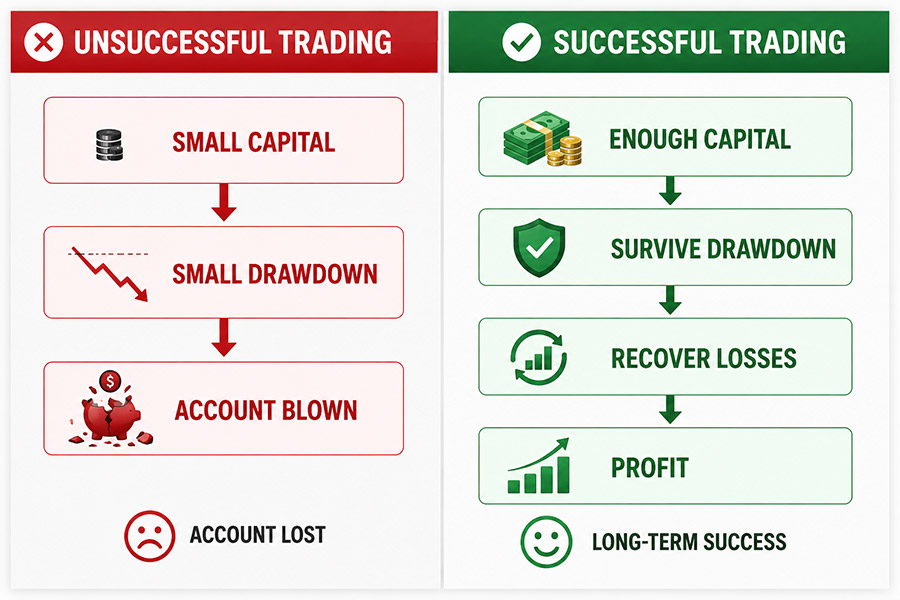
Imagine two traders using the same strategy.
The first trader starts with a very small account.
The second trader starts with sufficient capital.
When a difficult market period arrives, both accounts experience losses.
The difference is that the larger account can absorb the drawdown and continue trading.
The smaller account may not have enough funds to withstand the losses and could be wiped out before the strategy has an opportunity to recover.
This is one of the biggest disadvantages of trading with a small account.
The account simply does not have enough room to survive normal market fluctuations.

Lack of Experience Makes the Problem Worse
Beginner traders usually cannot accurately determine whether current market conditions are favorable or unfavorable.
The market may be calm today and highly volatile tomorrow.
Even traders who use automated systems face the same challenge.
Many people assume that using an EA eliminates risk.
This is not true.
Every EA is designed for specific market conditions. When those conditions change, the EA may experience a period of losses before adapting or recovering.
If the account balance is too small, the trader may lose the entire account before the recovery phase begins.
The Psychological Damage
Losing an account during the first days or weeks of trading can be extremely discouraging.
Many traders interpret this as proof that trading does not work.
As a result, some completely abandon Forex trading.
Others continue, but they repeat the same cycle:
- Deposit funds
- Lose funds
- Deposit again
- Lose again
After several repetitions, frustration replaces motivation.
The problem is often not the trading strategy itself. The problem is that the account size was never sufficient to handle the natural ups and downs of trading.

Survival + Recovery = Profit
We often tell traders that successful trading follows a simple formula:
Survival + Recovery = Profit
Before thinking about profits, a trader must first ensure that the account can survive difficult periods.
Once the account survives, it has an opportunity to recover.
Only after recovery comes profit.
Unfortunately, many traders focus only on the final part of the equation and completely ignore the first two.

How Much Capital Is Enough?
There is no universal answer.
The required capital depends on several factors:
- Whether you trade manually or automatically
- The level of risk you plan to use
- The type of strategy being traded
- The volatility of the instrument
- The characteristics of the EA, if you use one
Different systems require different account sizes.
However, as a general guideline, we often recommend:
• Around $500 for conservative scalping systems
• At least $1,000 for grid strategies or higher-risk EAs
These amounts are not guarantees of success.
They simply provide more room for the account to survive temporary losses and recover when market conditions improve.
Do Not Forget the Role of Timing
Trading success also involves a certain amount of timing and luck.
Starting during stable market conditions is very different from starting during periods of extreme uncertainty.
Major events such as financial crises, pandemics, geopolitical conflicts, or unexpected economic shocks can create abnormal market behavior.
Even good strategies may struggle during such periods.
This is another reason why having sufficient capital is important. It gives traders a better chance of surviving unusual market conditions.
Final Thoughts
Many traders believe that starting with a small account reduces risk.
In reality, the opposite is often true.
A small account has less ability to absorb losses, survive difficult market periods, and recover from drawdowns.
Before starting live trading, focus less on how quickly you can make money and more on whether your account can survive long enough to give your strategy a fair chance.
Because in trading, survival comes first. Profit comes later.

Comment(s) (0)